
Welcome to Renmore
Renmore is a mature residential area east of Galway City. It is bounded by the Dublin Road to the north and extends south to Galway Bay. This vibrant community boasts a range of educational, health and recreational facilities, extensive green spaces and beach areas.
There is a strong community spirit in Renmore, which has been fostered and built over time. We have a wide range of very active clubs and associations, including soccer, gaelic football, hurling, scouts, dance and performance schools, and active retirement activities, to name but a few. Local residents have worked together over the years to advocate for the acquisition of new facilities and ensure the maintenance of existing facilities, with the support of Galway City Council.
Renmore – Geography & Location
Renmore is a suburb located on the eastern side of Galway City on the western coast of Ireland. Located to the south of the old Galway to Dublin road, it is bounded by Lough Atalia to the west, Galway Bay to the south and the townland of Roscam to the east.
Much of Renmore lies within 3 kilometres of Galway city centre. The area is also close to centres of employment such as industrial estates and business parks. It is served by a number of bus routes providing access to Galway city centre, as well as Oranmore village and other surrounding areas.
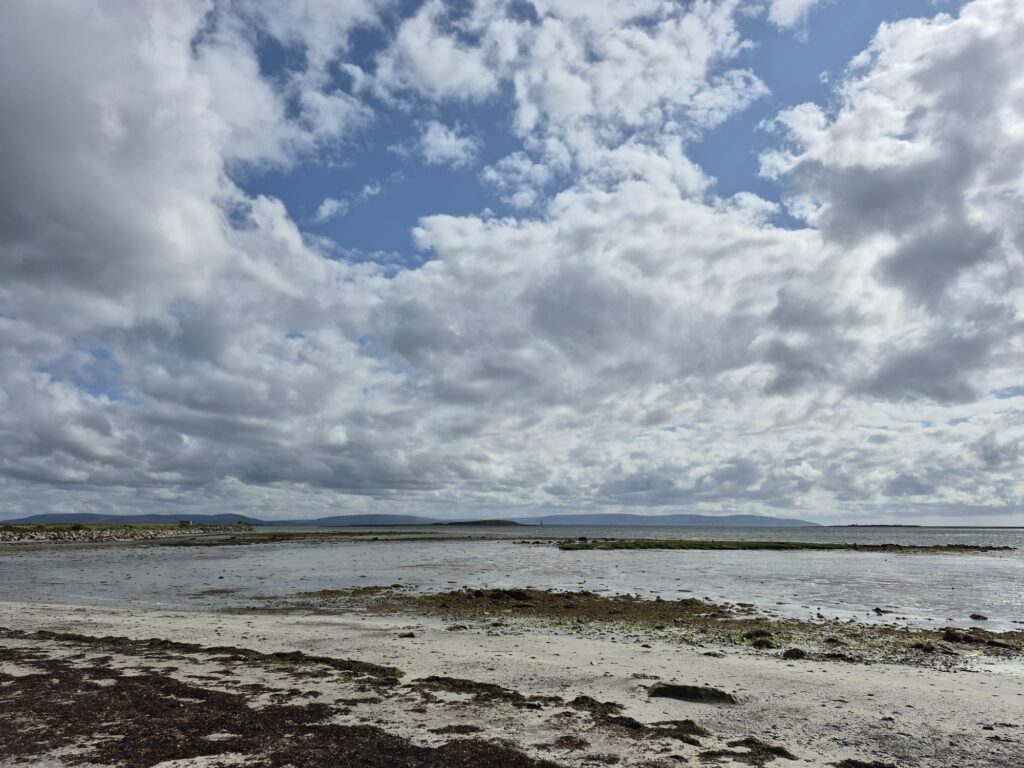
As well as a large amount of recreational green space, the area is also fortunate to have two beaches: Ballyloughane Beach, situated in the east of Renmore, with parking, toilet facilities, and a number of popular walking routes, and the more secluded Deadman’s Beach located in the west of Renmore.
Renmore – Its Place in History
The origin of the name Renmore is defined in Joyce’s Name of Places as a ‘large point of land’. The area is first mentioned in Hardiman’s History of Galway referring to the year 1643 when the city was threatened with invasion. The text reports that batteries were erected, one at Rintinnane on the west and another at Rinmore on the east, while a chain of works was stretched across the body of water to protect the city from possible invasion from the sea.
When the area first became habitable is open to question, but there is evidence of Fulachta Fiadh or ancient cooking sites on the shores of Lough Atalia, which date back to the Bronze and Iron Ages. Like any location in Ireland, the Renmore we see today is vastly different from the area it once was but its place in history has been identified and recorded.
An 11th century Norman Tower still stands to the east of Renmore, close to lands now occupied by Merlin Park Hospital. Ballyloughane village is perhaps the first location of a settlement in pre-modern times. The oldest house in the village is still standing and traces its origins back to the early 18th century. The main occupation of the villagers was farming, fishing and the harvesting of seaweed.
In the 1800s, the landlords established themselves in the rich grazing lands that gently sloped towards the sea in Renmore. Renmore House was occupied by the Wilson Lynch family and dates back to the early 1800s. Belmont was a Manor House on the estate and was located where the modern Belmont estate of houses is located today. Rosshill House was built in the 1830s by the Davenport family and Murrough House was built by the Blakes in the 1850s. Those houses still exist today. Renmore House has been incorporated into the Brothers of Charity complex, Rosshill is in private ownership and Murrough House has been acquired by ATU (formerly GMIT).
A key feature of Renmore is the Renmore Barracks or Dun Ui Mhaoiliosa, the location of An Céad Cath, the First Battalion of the Defence Forces, 4th Western Brigade. Built in the late 1870s and completed in the early 1880s the barracks has become synonymous with Renmore, and over the last 200 years has integrated fully with the local community.
The census of 1813 recorded 35 houses occupied in Renmore, or Rinmore as it was spelt then. Seven more houses were under construction, while five were recorded as unoccupied. The population was made up of 100 males and 85 females. The first of the modern houses in Renmore were built privately in the 1950s. Calvary Hospital was built in 1953; today the site is owned by the Bon Secours Hospital and operated as a modern private health facility.
More significant residential development began in the early 1960s, laying the foundations for the formal establishment of the parish of Renmore in 1971. Scoil Chaitríona Junior enrolled its first pupils in 1973, followed by Scoil Chaitríona Senior the following year, while the church of St. Oliver Plunkett was consecrated on 21 December 1975. Gaelscoil Dara opened its doors in 1984, offering families the option of primary education through the medium of Irish. Renmore is also home to the Galway Hospice and the Bons Secours Hospital. Over the decades, the area transformed into the thriving suburb it is today, while retaining many elements of a small local community.